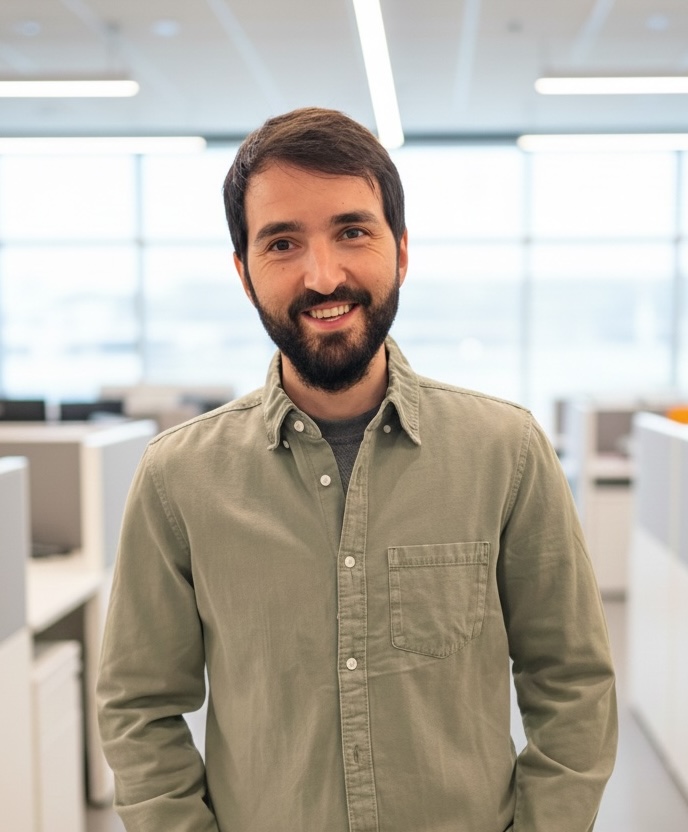
Portrait of Tolga Ergen

Research Scientist

Tolga Ergen

LG AI Research, Ann Arbor, MI  ·  Ph.D., Stanford University

I build large language model systems that are more capable, reliable, and efficient, spanning LLM agents, high-quality data generation, and scalable optimization for large models.

What I’m Working On

Current focus at LG AI Research
01

LLMs & Agents

Integrating large-scale language models with autonomous agents to build adaptive, intelligent systems. I am currently building web agents that operate directly in the browser: the LLM reads pages as compact text, acts through small, verifiable steps, and pauses to ask before taking any irreversible action. I also study how to make LLMs steerable through prompt optimization across tasks and languages.

02

Data Generation

High-quality synthetic data creation to improve model training, robustness, and performance. I work on generating and selecting data for training, evaluation, and preference learning, so models learn from the most informative examples.

About

I am a Research Scientist at LG AI Research in Ann Arbor, Michigan, where I work on large language models end to end: the agents built on top of them, the data they learn from, and the optimization methods that train them efficiently at scale.

I received my Ph.D. in Electrical Engineering from Stanford University, advised by Prof. Mert Pilanci. My dissertation developed convex optimization foundations for training neural networks, work recognized with the Adobe Research Fellowship and an ICASSP Outstanding Paper Award. That background still shapes how I approach LLMs today: with an eye for principled, efficient methods.

During my Ph.D., I interned at Google Research with Behnam Neyshabur and Harsh Mehta, and at Salesforce Research with Yu Bai. I received my B.S. and M.S. in Electrical and Electronics Engineering from Bilkent University, working with Prof. Suleyman Serdar Kozat.

Honors & Awards

2022

Adobe Research Fellowship

Adobe Research

2021

Outstanding Reviewer Award

NeurIPS 2021 · top 8% of reviewers

2021

Outstanding Paper Award

ICASSP 2021

2020

Best Poster Award

DeepMath 2020 · invited talk at DeepMath 2021

News

  • Feb 2026Our paper A Library of Mirrors, showing that deep neural nets in low dimensions are convex Lasso models with reflection features, has been accepted to the SIAM Journal on Mathematics of Data Science.
  • Jan 2026SPRIG, our work on improving LLM performance through system prompt optimization, has been accepted at ICLR 2026!
  • Dec 2025New preprint: Cross-Lingual Prompt Steerability, towards accurate and robust LLM behavior across languages.
  • Aug 2025Presented MapExplorer (formerly Map2Text), new content generation from low-dimensional visualizations, at KDD 2025 in Toronto.
  • Feb 2025Our paper on convex optimization theory and sparse recovery models has been accepted to IEEE Transactions on Information Theory.
  • Jan 2025New preprint: Clear Preferences Leave Traces, reference model-guided sampling for preference learning.
  • Jan 2025Paper accepted at Findings of NAACL 2025! We introduce MASSW, a large-scale text dataset on Multi-Aspect Summarization of Scientific Workflows for AI-assisted scientific innovation.
  • Dec 2024New preprint: Map2Text, new content generation from low-dimensional visualizations.
Show older newsShow less

Experience & Education

Work

  • Research Scientist
    LG AI Research, Ann Arbor, MI
    Jul 2023 – Present
    LLM agents, data generation, and efficient optimization for large language models.
  • Research Intern
    Google Research, Mountain View, CA
    Jun 2022 – Sep 2022
    Convex optimization perspectives on transformer networks. Hosts: Behnam Neyshabur, Harsh Mehta.
  • Research Intern
    Salesforce Research, Palo Alto, CA
    Jun 2021 – Sep 2021
    Gradient-based uncertainty quantification under distribution shift. Host: Yu Bai.

Education

Teaching

Teaching Assistant
  • EE269Fall 2019, 2020, 2021Signal Processing for Machine LearningStanford
  • EE270Winter 2020, 2021Large Scale Matrix Computation, Optimization and LearningStanford
  • EE364BSpring 2020, 2021Convex Optimization IIStanford
  • EEE424Fall 2016, 2017, Spring 2018Digital Signal ProcessingBilkent
  • EEE102Spring 2018Introduction to Digital Circuit DesignBilkent

Academic Service

Reviewer
NeurIPSICMLICLRIEEE TNNLSIEEE SPL